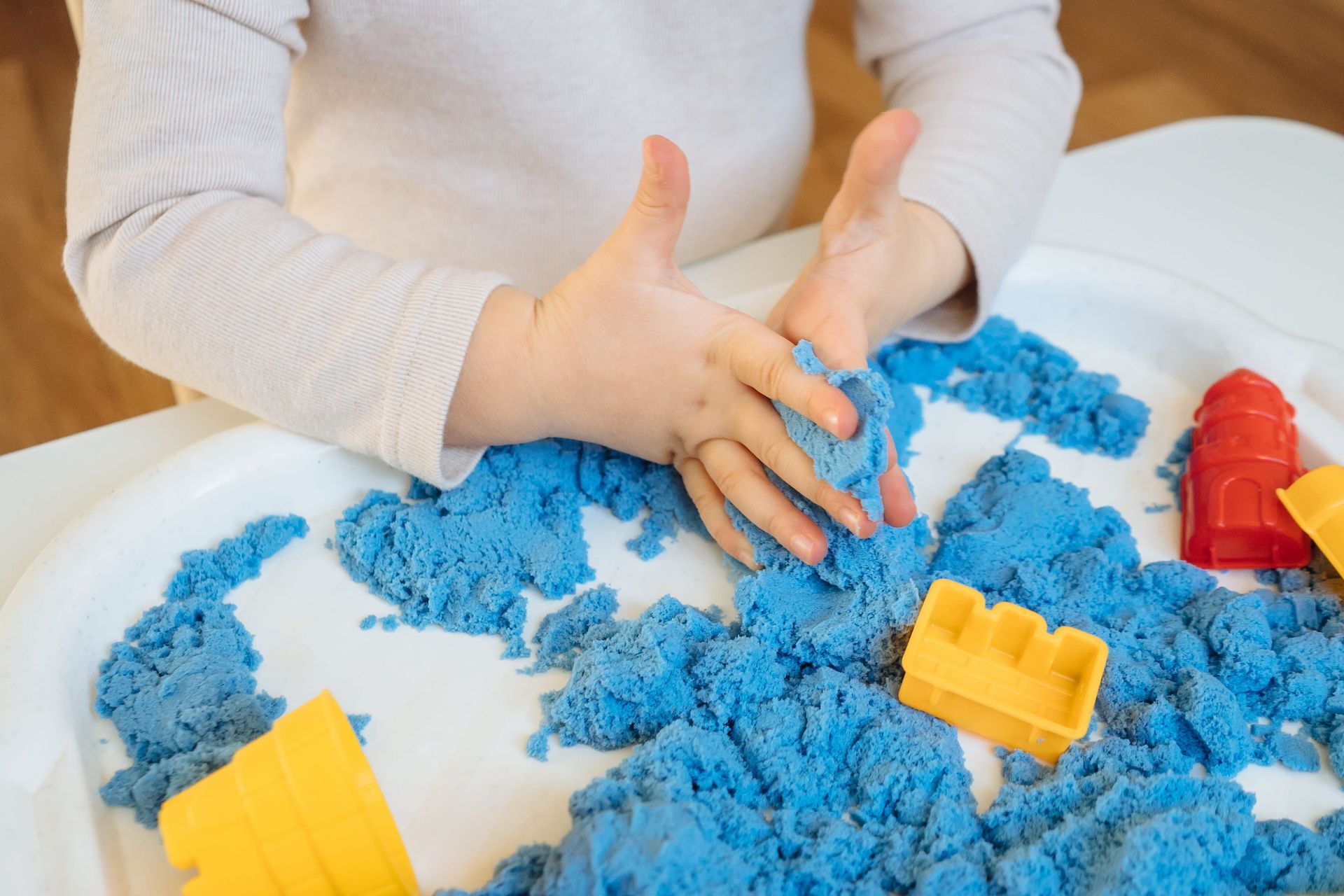
Ask a young child how their day went and you’ll often get one word. Ask a child who has been through something hard to explain how it felt, and you may get a shrug or a change of subject. Children often feel far more than they can put into sentences, especially after something frightening, confusing or painful.
Sand tray therapy gives children another way in. A child builds a scene in a tray of sand using small figures and objects, and we pay attention to what they create and how they play with it. This guide covers what it is, how it compares to sandplay therapy, what a session looks like, and how our team at Grimsby Counselling Centre uses it with children and youth in Grimsby, Ontario.
What Is Sand Tray Therapy?
Sand tray therapy is an expressive therapy in which a child uses a tray filled with sand and a collection of miniature figures to create a scene. The figures might include people, animals, houses and fantasy characters. Each figurine is chosen by the child, who decides where it sits and what happens next while we follow along.
The approach grows out of the work of Margaret Lowenfeld, a paediatrician who founded one of the first psychological clinics for children in England in 1928. According to the
International Society for Sandplay Therapy, her "World Technique" used a sand tray and miniatures so children could represent their inner world. It also sits within the wider field of play therapy, which the
Association for Play Therapy describes as working in the "language" of the child, which is play.
Sand Tray Therapy, Sandtray Therapy and Sandplay Therapy: What’s the Difference?
You will see these terms used online, sometimes as if they mean the same thing. They overlap, but sandplay therapy is a more specific method.
Sandplay therapy was developed in the late 1950s by Dora Kalff, a Jungian psychologist who had studied with Lowenfeld, according to the same ISST history. The
Sandplay Therapists of America describe it as non-directive: the client decides the content and direction of the work in the sand, and the therapist acts as "an active witness and guide."
Sand tray therapy is often used as the wider term, and depending on the child it can be more or less guided. For a parent, the more useful question is usually what sessions will look like for your own child, which we cover below.
How Sand Tray Therapy Helps Children Beyond Traditional Talk Therapy
Conversation-based therapy asks a child to name a feeling, find words for it and explain it to an adult. That is a lot to ask of a child whose language is still developing, and more so if what happened was frightening or confusing. For some children, traditional therapy built around conversation can come later, once they feel more settled.
Sand tray therapy may feel less intense in the meantime, because the child can look at a scene instead of at an adult. It is also developmentally appropriate, because play is how children naturally communicate.
The Healing Power of Play: How Sand Can Help Children Show What They Carry
A child doesn’t have to retell what happened for the work to begin. Through symbolic play, a figure can stand in for a person, a fear or a wish. Using sand, children create scenes that reflect their life experiences, and watching the play unfold helps us gain insight into what a child is carrying. For many children this is a way to express emotions that don’t yet have names, a way to process feelings at a distance, and a chance to explore their inner world at their own pace.
Scenes can change over time. In a
study published in Frontiers in Psychology, researchers followed seven children aged 7 to 10 who had experienced abuse. Across six months of treatment, their sand scenes tended to move from static arrangements to stories with action, and from chaotic layouts toward more coherent ones. Later scenes included places of protection and more hopeful endings. It was a small study with limits of its own, so we treat it as one useful look at how sand play can change during treatment.
There is a tactile experience too. A child can pour, smooth and dig in sand, and many therapists find that this hands-on contact is grounding for children who feel tense or keyed up. It can help regulate the nervous system in a way that answering questions across a table often does not, and it gives big emotions somewhere to go.
What Happens in a Sand Tray Therapy Session
Sessions for children don’t look like adult therapy. At our Grimsby office, we first meet briefly with parents to understand the full picture before meeting your child. Your child then comes into the therapy room, where the trays and materials are set out as a supportive space for play. If a child isn’t ready to touch something, we don’t push. We move at the child’s pace.
From there, a session might involve building a scene and talking about it, building in silence, or simply using the sand for a while before anything takes shape. Some children narrate every move and others work quietly. The therapist follows the child’s lead and may ask gentle questions about the scene if the child wants to talk.
Parents stay informed throughout. We offer a brief check-in before or after sessions as needed, so you know what is happening without being inside the room.
Sand Tray Therapy Techniques a Therapist Might Use
The therapeutic approach adapts to the child. A therapist may offer an open invitation to make whatever they like, or a gentle prompt, such as building a place they would like to visit or one that worries them. A child might use a tray to build a calm place, or use sand and miniature figures to act out something that happened at school. They may invite the child to move figures through the scene and notice what happens, or return to an earlier scene and see whether the child wants to change it.
Many trays come in dry and wet versions, which the same group explains allow different kinds of expression. Some children prefer the dry sand and others want to dig and shape it wet.
We keep the child’s meaning at the centre of every scene. We pay attention to patterns across scenes and to how the play changes, and use that to decide what support a child needs next.
Therapies Like Sand Tray Therapy: Play Therapy, Art Therapy and EMDR
This is one of several creative therapy options built around how children actually communicate. Play therapy uses toys, games and imagination. Art-based work, like art therapy, uses drawing, painting and clay. Each is a form of creative expression, and therapists use them to help clients show something without describing it first.
Our team works primarily with sand tray, art-based approaches, and
EMDR adapted for children and adolescents. Which one fits depends on the child, their age and what they are ready for. Sand tray work can be used with children who’ve experienced trauma, and it can also support children dealing with anxiety, grief or big changes at home or school. Our
trauma therapy page explains more about how we approach that work.
What If Sand Tray Therapy for Children Feels Like Too Much?
This is a fair question for any parent to ask. Here is how the pace is protected:
- The child sets the speed. Nothing is required of them, and a scene can stay as symbolic as the child wants.
- A child doesn’t have to describe what happened. The play can carry the story.
- You meet with us before your child does, and you get regular check-ins afterwards.
- If a child isn’t ready for part of the work, we adjust.
Emotional safety comes first, and it is what makes the rest possible. Many therapists consider the sand tray a powerful tool for this reason: a child can approach a hard experience from a distance, through a scene, and come closer only when they are ready. That kind of healing through play can support emotional healing without asking a child to relive anything.
Frequently Asked Questions
Does my child have to talk about what they build?
No. Some children explain every detail and others say nothing, and both can benefit. The therapist follows the child’s lead.
What age is this for?
We work with children and teenagers across a range of ages and adapt our approach to each child’s developmental stage. Sessions with teenagers tend to feel more conversational. If you’re unsure whether your child’s age is a good fit, you can ask us during a free consultation.
Who is sand tray therapy for?
Anyone who would like to give it a try. Whether your child is dealing with anxiety, grief, a big change, a hard experience, or simply has trouble putting feelings into words, everyone is welcome. Since it doesn’t depend on talking, it also works for teens and adults, and some find a scene easier to start with than a sentence.
Will I be in the room?
Usually not. Brief check-ins before or after sessions keep you connected to the process without putting you inside the room.
How long until I notice a difference?
It varies from child to child, and we don’t promise a timeline. Parents may begin by noticing small things, such as a child naming a feeling or seeming a little less guarded.
Takeaways and Next Steps
Children often can’t explain what they’re carrying, and the sand tray lets them show it first. The sand and figures, along with the pace of the session, do much of the work, and our role is to follow along, understand, and offer support when it is needed.
If you are wondering whether this could suit your child,
book a free 15-minute consultation. You can ask about your child’s age, what a first session looks like, and anything else you would like to know before deciding. You can also read more about
counselling for children and youth in Grimsby.